Nexgrill Oakford 1400 Review: How to Evaluate a Large Oakford Pro Pellet Smoker Before You Buy
A practical, evidence-based review guide to the Oakford Pro pellet platform - how to judge capacity, temperature control, and value, and how to confirm the exact model you're buying.
In This Article
Verify the Model Number
Review by Real Specs
Setup and First Cook
How to Review a Large Oakford Pro Pellet Smoker Before You Buy
Oakford model labels shift between retail listings, seasonal bundles, and cooking-area numbers, so a search for 'Oakford 1400' can return product pages that do not match each other on specs. This guide shows you how to review any large Oakford Pro on real, checkable numbers so that whether the unit in front of you is an 875, an 1125, or a larger-capacity tier, you know exactly what you are buying.
Nexgrill has been building outdoor cooking equipment since 1993 and is headquartered in California, with strong distribution through US retail partners. Pellet units depend on augers, fans, controllers, RTD probes, and a steady supply of replacement parts, so a brand with broad US retail reach and a merged parent (Nexgrill combined with Megamaster to form Global Leisure) is generally easier to get parts from than a specialty importer.
Verify the exact model number and spec sheet before you buy. Oakford naming varies across listings. Treat any '1400' figure as a capacity or bundle designation you must confirm in writing on the product page you are actually purchasing from.
First, Confirm Which Oakford Pro Model You're Actually Looking At
Before reading a single review comment, open the product page and write down four things: the full model name, the primary cooking area in square inches, the hopper capacity in pounds, and the listed temperature range. If a retailer's page does not state all four, ask the seller or check the Nexgrill listing for the closest matching model. Third-party reviews frequently blend specs from two different Oakford SKUs, which is how myths about a model's real capacity or heat ceiling start.
Build a small spec card for every candidate. Compare two verified reference points side by side using Oakford 875 Pro and Oakford 1125 Pro pages, then match the larger-tier unit you are shopping against those numbers rather than against a model number that may not exist on Nexgrill's own catalogue.
What the Oakford Pro Pellet Platform Delivers (Using the 875 and 1125 as Reference Points)
Pellet grills in this class are typically marketed as 8-in-1: smoke, grill, bake, roast, braise, BBQ, char, and warm. The 875 and 1125 names track the primary cooking area in square inches, which is why a '1400' style label almost certainly refers to a larger cooking surface rather than a different mechanism. The platform is consistent across the tier: a hopper-fed auger pushing hardwood pellets into a fire pot, a combustion fan, an RTD temperature sensor, and a digital controller managing pellet feed to hold a set point.
- Fuel: food-grade hardwood pellets (hickory, apple, cherry, competition blends).
- Heat source: fire pot with an igniter rod, variable-speed auger, and combustion fan.
- Control: digital set-point controller with an RTD probe; some models add a meat probe.
- Cooking modes: low-and-slow smoke through high-heat searing, plus indirect roast and bake.
The larger tier adds cooking real estate and, in most listings, a taller lid and additional upper rack. What it generally does not change is the controller logic, so temperature behaviour on a large Oakford Pro should be evaluated the same way you would evaluate a mid-size unit.
How to Evaluate Cooking Capacity: Square Inches, Rack Levels, and Real Feeds
Advertised square inches are almost always the sum of the main grate plus any upper rack, and sometimes the warming rack too. Ask two questions: how many square inches are on the main grate alone, and how many usable rack levels exist? A three-rack configuration lets you smoke a brisket on the main grate, chicken on the middle, and sides on top during the same cook.
Typical low-and-slow set point for pork butt and brisket; check a unit's ability to hold this within roughly ±15-25°F, per most reviewers.
A full packer brisket can run 12-18 lb and needs 18-24 in of flat grate length. Two full racks of St. Louis ribs need roughly 24 in of width if laid flat. If a large Oakford Pro claims roughly 1,400 in across all racks, expect the main grate to be in the 700-900 in range - enough for a brisket plus sides, but not for three briskets at once.
Temperature Range, Control, and Heat-Up Time: What to Test and What to Expect
Pellet grills in this class generally advertise a range from about 180°F for smoke up to 450-500°F for grilling and searing. A standard set-point PID-style controller holds temperature better in cold or windy conditions than a simple timed-feed controller. In practice, a well-tuned large pellet grill reaches 225°F from cold in roughly 12-20 minutes, depending on ambient temperature and pellet quality.
Judge a unit on three repeatable measurements:
- Overshoot: does the grill sail past the set point after ignition, then settle?
- Recovery: how fast does it return to set point after you open the lid for 30 seconds?
- Spread: is the left-to-right variance across the grate within 25°F at 250°F?
If a review does not report at least overshoot and spread, treat the temperature discussion as marketing rather than data.
Build Quality and Materials: What to Inspect on the Unit
Walk the floor model, or examine high-resolution photos before ordering online, and check five points. First, lid weight and seal: a heavy lid with a tight gasket holds heat and reduces pellet burn. Second, fire pot and auger access: you should be able to reach the fire pot for cleaning without disassembling the hopper. Third, steel gauge on the cook chamber and cart: thicker gauge resists warping at high heat. Fourth, powder-coat versus stainless exterior: powder-coat is fine for most US climates if you cover the grill; stainless resists coastal salt air better. Fifth, wheels and cart rigidity: a large-capacity grill with a full hopper can exceed 150 lb, so locking casters and a braced cart are not luxuries.
Warranty and Parts Support: A Real Differentiator in This Price Class
Pellet grills are mechanical: augers jam, igniters fail, controllers drift. Warranty length and coverage vary by component, and Nexgrill's warranty terms should be read on the specific product page rather than assumed. Before purchasing, confirm which parts are covered, for how long, and whether shipping is included on replacements. Nexgrill's US retail footprint and its company background are a reasonable proxy for parts availability, but the specific terms are what protect you.
Do not assume a warranty length from a review. Warranty terms are stated per model and can change by season. Read the current terms on the exact product page you are buying from.
What to Look For: A 5-Point Review Checklist for Any Large Oakford Pro
| Criterion | What to Confirm | Why It Matters |
|---|---|---|
| Main grate area | Square inches on the primary grate alone, and number of rack levels | Determines whether a brisket plus sides fits on one cook |
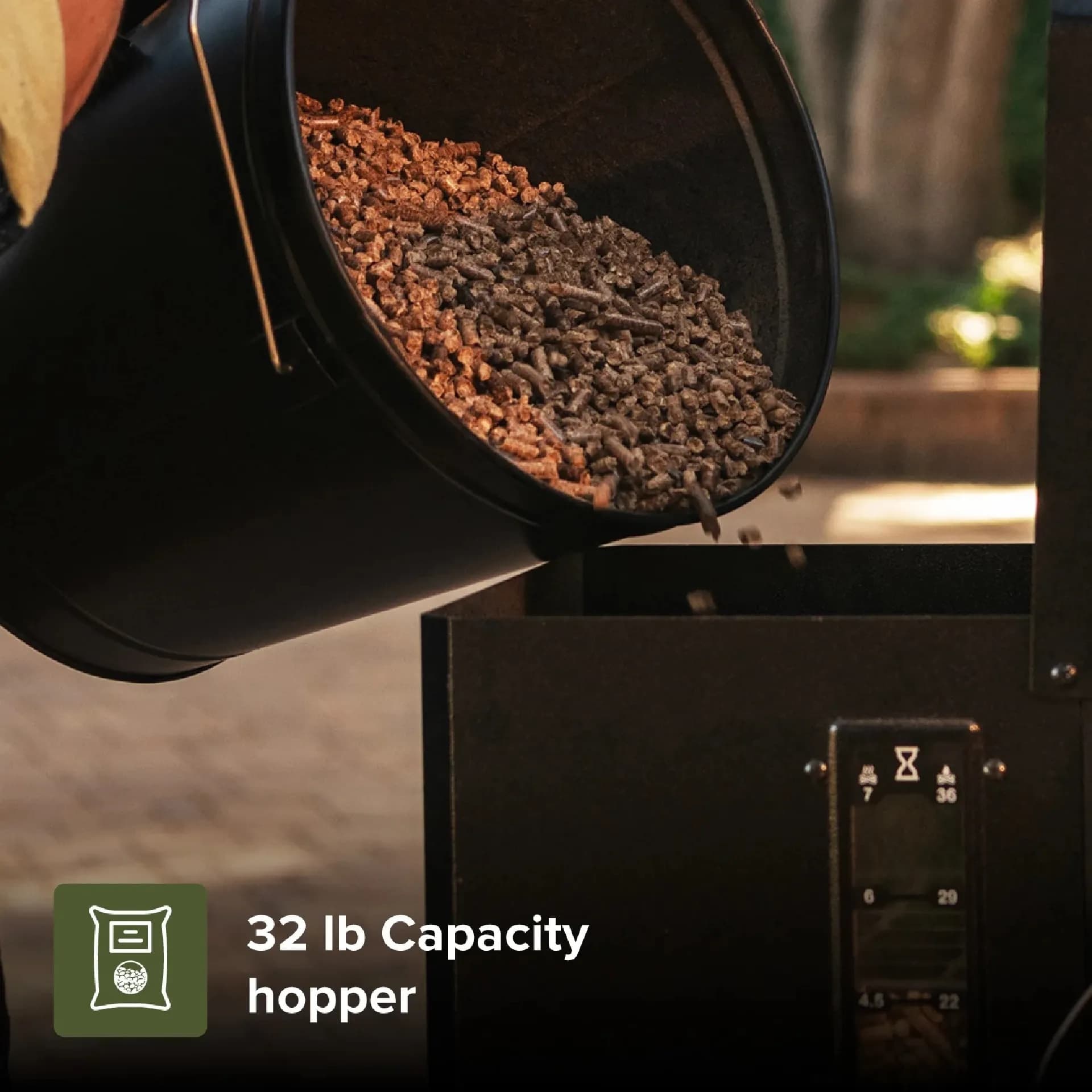
| Hopper capacity | Pounds of pellets, and expected burn time at 225°F | A long cook should not require a mid-cook refill |
| Controller and probes | Controller type, probe count, calibration method | Temperature control is the biggest performance differentiator |
| Build materials | Steel gauge, lid seal, fire pot access, cart rigidity | Drives lifespan, heat retention, and clean-out ease |
| Warranty and parts | Covered components, duration, shipping policy | Protects you against auger, igniter, and controller failures |
Try comparing two products side by side below to see which fits best:
Once You've Weighed Two Options Against Each Other, Here's What Else Matters
A side-by-side comparison settles capacity and price. What it does not settle is whether the unit fits your patio, your outlet, and your cooking calendar. Before you commit to a large Oakford Pro, confirm your space and power. You need a level, non-combustible surface - a patio slab, concrete pad, or composite deck with an approved mat - with roughly 3 ft of clearance from walls, fences, and vinyl siding, and overhead clearance from eaves and low branches. You also need a standard US 120V GFCI outlet within reach of the power cord on an outdoor-rated extension cord. Budget for pellets, a fitted cover, and a probe thermometer if the unit does not include one. Assembly of a large unit is realistically a two-person job in the 45-90 minute range; open the box in the driveway, not on the deck, so you can inventory hardware before moving heavy panels.
Step-by-Step: How to Set Up and Season an Oakford Pro Pellet Smoker
- Unbox and inventory. Lay out all panels, hardware, and the manual. Match every part against the parts list before starting.
- Assemble in order. Build the cart and legs first, then mount the hopper and fire pot assembly, then the lid and controller. Following the manual's sequence prevents rework and keeps the unit stable as it gains weight.
- Burn off the manufacturing oils. Fill the hopper about halfway with a basic blend, prime the auger per the manual, and run the grill at 400-450°F for 30-45 minutes with the lid closed. Expect some smoke and odour; this is normal and dissipates.
- Verify temperature with an independent probe. Set the controller to 250°F and allow 20 minutes to stabilise. Compare a calibrated third-party probe at grate level against the controller reading. Many controllers allow a calibration offset; adjust only after confirming the discrepancy.
- Run a first cook that tolerates variation. A 6-8 lb pork butt or a spatchcocked chicken is ideal. Both forgive temperature swings and give you a read on fuel consumption, smoke quality, and hopper burn time.
- Establish a clean-out and pellet-storage routine before your second cook. Vacuum the fire pot and ash from the cook chamber after every 2-3 sessions, and store pellets in an airtight container away from humidity.
Follow USDA FSIS guidance for safe smoking: keep the grill in the 225-300°F range for low-and-slow cooks, and use a food thermometer - colour is not a reliable indicator of doneness.
Common Mistakes That Undermine Pellet Smoker Performance
- Skimping on the initial burn-off, which leaves manufacturing residue that affects flavour on the first cook.
- Using damp or dusty pellets, which bridge in the hopper, starve the auger, and cause temperature swings or flame-outs.
- Skipping probe calibration, which makes you chase a controller that is actually reading correctly.
- Mixing pellet types stored in different conditions, which changes burn characteristics mid-cook.
- Leaving pellets in the hopper between cooks in humid climates, where they swell and jam the auger.
- Leaving the grill uncovered. Rain and UV degrade the controller, igniter, and powder coat.
Never leave a pellet grill unattended on its first few cooks. Learn its behaviour - overshoot, recovery, and ash production - before you trust it with an overnight brisket.
Which Oakford Pro Buyer Are You? Matching Profiles to the Right Tier
| Buyer Profile | Typical Needs | Recommended Tier |
|---|---|---|
| Weekend cook, 2-4 people | Chicken, ribs, occasional brisket; limited patio space | Mid-size Oakford Pro (875-class) |
| Entertainer, 6-12 guests | Multiple proteins at once, side dishes, long cooks | Large Oakford Pro (1125-class or larger) |
| Competition-style home cook | Brisket plus two butts, precise temperature control, probe accuracy | Largest capacity with a PID-style controller |
If you routinely cook for more than eight people, the largest tier is the right call even if it costs more upfront. If you cook for two or three most weekends, a mid-size unit will burn less fuel and take up less patio space.
Operating Cost, Pellet Consumption, and Long-Term Value in the US
Pellet consumption depends on set point, ambient temperature, and wind. As an estimate, a mid-size pellet grill at 225°F consumes roughly 0.5-1 lb of pellets per hour in mild weather, and a large-capacity unit can consume 1-1.5 lb per hour or more in cold or windy conditions. At typical US retail prices of roughly $1.00-$1.50 per pound for quality hardwood pellets, a 12-hour brisket cook on a large unit can cost somewhere between $15 and $25 in fuel. Add the small electricity draw for the auger and fan. These are estimates; actual figures vary by pellets, weather, and controller behaviour.
Value in this class comes down to lifespan per dollar. A large Oakford Pro with a powder-coated body, covered when not in use, cleaned regularly, and kept on a level surface should deliver multiple seasons of service. Parts availability - the reason to buy from a brand with an established US retail footprint like Nexgrill - is what keeps a grill out of the landfill when an igniter or controller eventually fails.
Maintenance and Storage: Keeping a Large Pellet Grill Running Season After Season
- After every cook: brush the grates once warm, then close the lid.
- Every 2-3 cooks: vacuum the fire pot and ash from the cook chamber; scrape the drip tray.
- Monthly during use: inspect the auger for pellet dust, check the RTD probe for residue, and confirm the igniter fires cleanly.
- Seasonally: check the lid gasket, tighten cart hardware, and inspect the power cord for wear.
- Off-season: empty the hopper completely, run the auger dry, vacuum the fire pot, cover the grill, and store pellets in airtight containers indoors.
Final Checklist Before You Commit to a Large Oakford Pro
- Confirmed the exact model number, main grate area, hopper capacity, and temperature range on the listing.
- Verified patio clearance, level surface, and outdoor-rated power access.
- Read the current warranty terms for the specific model.
- Budgeted for pellets, a cover, and a calibrated probe thermometer.
- Planned a two-person assembly window and the initial burn-off time.
- Committed to a clean-out and pellet-storage routine from day one.
If all six items check out, the remaining decision is capacity and price between the 875, the 1125, and any larger-capacity tier your retailer lists under the Oakford Pro name. Review by specs, not by label.