Nexgrill 820-0061 Review: Trace an Unknown Model Number Before You Buy
A verification-first how-to for anyone who searched 820-0061 and found no matching Nexgrill grill - identify the unit in 15 minutes, then judge it on real evidence.
In This Article
Verify Before You Review
Trace It in 15 Minutes
Judge the Grill Itself
Nexgrill 820-0061 Review: Why the Number Doesn't Match Anything Nexgrill Documents
If you landed here after searching for a “Nexgrill 820-0061 review,” you've likely already noticed the problem: Nexgrill's documented gas grills carry model strings in the 720- series (720-0925PG, 720-1046A, 720-0896B, 720-0830H). The number 820-0061 does not appear in Nexgrill's public catalogue, and as of this writing there is no verified product page for it on nexgrill.com or at major U.S. retailers. That doesn't mean the grill in front of you is fake - it means the number got detached from its context somewhere along the way. This guide is a verification-first how-to: trace that string, confirm what you actually own, then evaluate the grill on evidence rather than a listing title.
Nexgrill was founded in 1993 and later merged with Megamaster to form Global Leisure. Its current lineup spans gas, pellet, charcoal, and griddle platforms - all documented under consistent model-family naming. A number that breaks that pattern deserves a second look before money changes hands.
What 820-0061 Could Actually Be: Part Code, Retailer SKU, or Transposed Model Number
Before you spend another hour searching, consider the three most common explanations for a number that resolves nowhere:
- Part or accessory code. Nexgrill and its retail partners sell replacement burners, heat tents, igniters, and regulator assemblies under their own part numbers. These often look similar to model strings but belong to a component, not a whole grill.
- Retailer SKU or vendor code. Large U.S. retailers assign internal SKUs that can appear on shelf tags, receipts, or marketplace listings. A Home Depot SKU, for example, is not the manufacturer's model number and will not appear in Nexgrill's parts lookups.
- Transposed or misread digits. Rating plates are stamped or printed and can be smudged. “820-0061” is one digit away from several plausible 720-series strings. A single flipped digit between 7 and 8, or a misread 2 as 8, is surprisingly common on used-marketplace photos.
None of these possibilities makes the grill worthless - but each changes what you should do next. The tracing steps below are designed to separate them quickly.
Before You Start: Five Things to Have in Hand (Rating Plate Photo, Receipt, Tape Measure)
You can complete the trace in about 15 minutes if you gather these first:
- A clear, well-lit photo of the rating plate (also called the data plate) - usually inside the cabinet, on the back of the firebox, or under the side shelf.
- The original receipt, order confirmation, or marketplace listing screenshot, if you have one.
- A tape measure for cooking-grate dimensions and overall width.
- A flashlight for reading stamped metal.
- A notepad or phone note to record every line verbatim.
Tip: photograph the plate straight-on, not at an angle, and take a second shot with a flashlight raking across the surface - stamped digits often appear only under side light.
Step 1: Photograph the Rating Plate and Copy Every Line Verbatim
The rating plate is the single most reliable identifier on any gas grill. Copy everything: model number, serial number, gas type (propane or natural gas), BTU rating per burner and total, manifold pressure, and any safety-certification marks. Do not “clean up” the number as you write it - if it looks like 820-0061, record it exactly that way, then note any characters that are ambiguous. Many plates include a separate “serial” or “S/N” field; keep those distinct from the model field.
If the plate is missing or unreadable, move to Step 4 and match by physical features. A missing plate is not a dealbreaker on a used grill, but it does mean you cannot rely on any model number a seller quotes.
Step 2: Run the Exact String Through Nexgrill's Parts and Manual Lookup
Search the exact string “820-0061” on Nexgrill's product catalogue and on its support pages. Also try the string with common suffixes (A, B, PG) and with a leading 7 instead of 8. If the exact string returns no grill, note that result - it's evidence. Then search for the string plus “parts” or “manual” to see whether it resolves to a component rather than a whole unit.
Warning: be wary of third-party sites that auto-generate “review” pages for any model number. If a page has no photos, no specifications, and no manufacturer link, it is not a source - it is a keyword trap.
Step 3: Check the Retailer Listing and Receipt Against the Plate
If you bought the grill new, compare the model number on your receipt or order confirmation with the plate. Retailer systems sometimes record the SKU rather than the manufacturer model. If you're looking at a used listing, ask the seller to photograph the plate and compare it with the listing title. A mismatch between the listing title and the plate is a red flag - but it's also your fastest route to the real number.
Step 4: If the Number Still Won't Resolve, Match the Unit by Physical Features
When the number is a dead end, the grill itself becomes the evidence. Measure the cooking area and count the burners, then compare those facts with documented Nexgrill 720-series models. The matrix below gives you a structured way to narrow the family.
Feature-Matching Matrix: Burner Count, Side Burner, Cart Style, Lid Material
| Feature | What to Record | Why It Narrows the Search |
|---|---|---|
| Burner count | Count main burner tubes under the grates | Most 720-series grills are 2-, 3-, 4-, 5-, or 6-burner; the count eliminates whole families |
| Side burner | Present or absent; if present, measure its grate | Side burners are model-specific and often change the suffix letter |
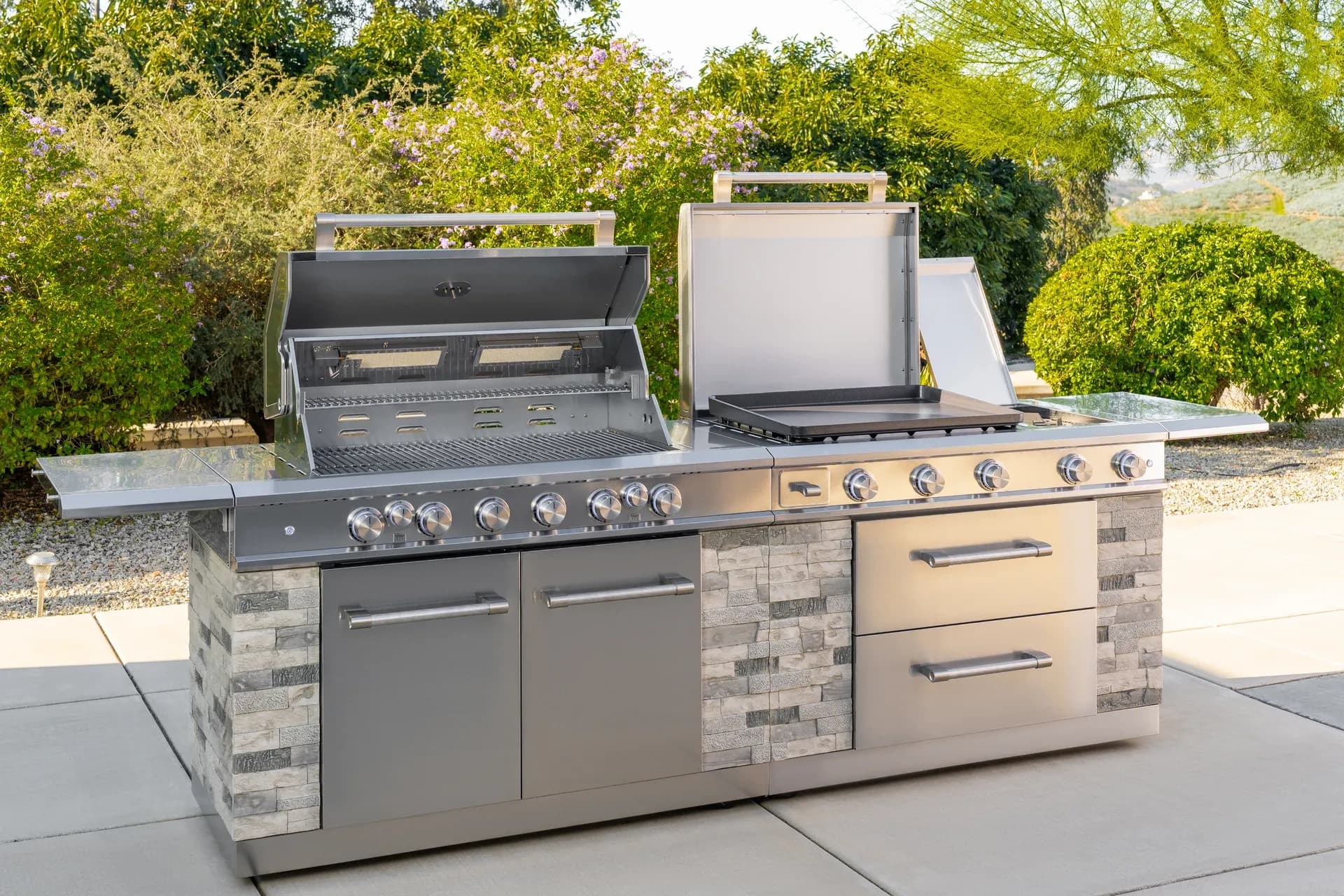
| Cart style | Open cart vs. enclosed cabinet; wheel type | Cabinet models typically sit higher in the range |
| Lid material | Stainless steel vs. painted steel; thermometer present | Stainless lids correlate with premium trim levels |
Record each feature, then search Nexgrill's catalogue for a 720-series model that matches all four. You may not find an exact match, but you'll typically land within one family - enough to source common parts like heat tents and igniters. If you want to compare two candidate models directly, try the side-by-side tool below to see which fits best.
Once you've weighed two options against each other - whether that's two used listings, two candidate model numbers, or a used unit versus a new one - the decision usually comes down to condition and documented support, not the number on the sticker. Here's how to evaluate what you're actually buying.
Step 5: Test the Grill Itself - Leak Test, Igniter Spark, Flame Colour, Heat Tents
A grill that passes these four checks is a usable grill regardless of what the plate says. A grill that fails them is a project, and you should price it accordingly.
- Leak test. With the tank valve open and burners off, brush soapy water on every connection: tank-to-regulator, regulator-to-hose, hose-to-manifold. Bubbles mean a leak - replace the hose or regulator before lighting. The U.S. Fire Administration and CPSC both emphasize leak checks as a core outdoor-grill safety step.
- Igniter spark. Listen and watch for a crisp spark at each burner. Weak or intermittent spark often means a dirty electrode or a worn igniter wire, both inexpensive fixes.
- Flame colour. Light the burners and let them run for two minutes. A healthy propane flame is mostly blue with slight yellow tips. A persistently yellow, lazy flame can indicate a blocked burner tube, incorrect orifice, or spider webs - inspect and clean the tubes before cooking.
- Heat tents. Lift the cooking grates and inspect the heat tents (flame tamers) above each burner. Heavy rust-through or missing tents cause flare-ups and uneven heat; replacements are widely available for 720-series models.
Warning: never test a used grill indoors or in a garage. Carbon monoxide is odourless and lethal; run every first-fire test outdoors, away from walls and overhangs.
Using Documented 720-Series Models as Benchmarks (Approximate Ranges Only)
Because no verified specification exists for 820-0061, the only honest way to judge a mystery unit is against documented models in the same class. The table below shows approximate ranges for common 720-series configurations - treat these as ballparks, not quotes for your specific grill.
| Class | Typical burner count | Approx. total BTU | Approx. cooking area |
|---|---|---|---|
| Compact / 2-burner | 2 main | 20,000-30,000 | 250-350 sq in |
| Mid-size / 4-burner | 4 main (+ side burner on some) | 40,000-60,000 | 450-650 sq in |
| Large / 5-6 burner | 5-6 main | 60,000-80,000 | 650-900 sq in |
If your measured cooking area and burner count fall outside these ranges, you may be looking at a non-Nexgrill unit with a Nexgrill sticker, or a commercial/older model. That's useful information before you buy parts.
Who This Is For: Used-Marketplace Buyer, Existing Owner, and Retail Shopper
The right next step depends on why you searched this number:
- Used-marketplace buyer. Ask for a plate photo and a photo of the burners with the lid open. If the seller can't provide either, walk away - the price should reflect “unknown model” risk.
- Existing owner hunting parts. Use the feature matrix to identify the closest 720-series family, then search that family's parts list. Common wear items - heat tents, igniters, burner tubes, regulator hoses - are often shared across several models.
- Retail shopper who saw the number online. Verify the model against Nexgrill's catalogue and the retailer's own product page. If neither shows the number, treat the listing as unverified and look at current models with documented support.
The Four Mistakes That Sink an '820-0061' Purchase
- Paying a premium for a mystery model. Without documented specs, the unit should be priced below a comparable documented 720-series grill - not above it.
- Skipping the leak test because “it looks fine.” Visual condition says nothing about hose integrity. A $10 hose is cheap; a fire is not.
- Buying parts before confirming the family. A burner tube for a 6-burner will not fit a 4-burner frame. Confirm the class first, then order.
- Trusting a screenshot over the plate. Marketplace photos are often of a different unit. Insist on a plate photo taken today.
Pre-Purchase and First-Fire Checklist
- Rating plate photographed and every line copied verbatim
- Burner count and cooking area measured
- Leak test completed with soapy water on all connections
- Igniter spark confirmed at each burner
- Flame colour checked after two minutes of operation
- Heat tents inspected for rust-through or missing pieces
- Price compared against documented 720-series benchmarks
If the number still won't resolve and you want a grill with full documentation and support, browse Nexgrill's current lineup - every model there comes with a spec sheet, manual, and parts availability.