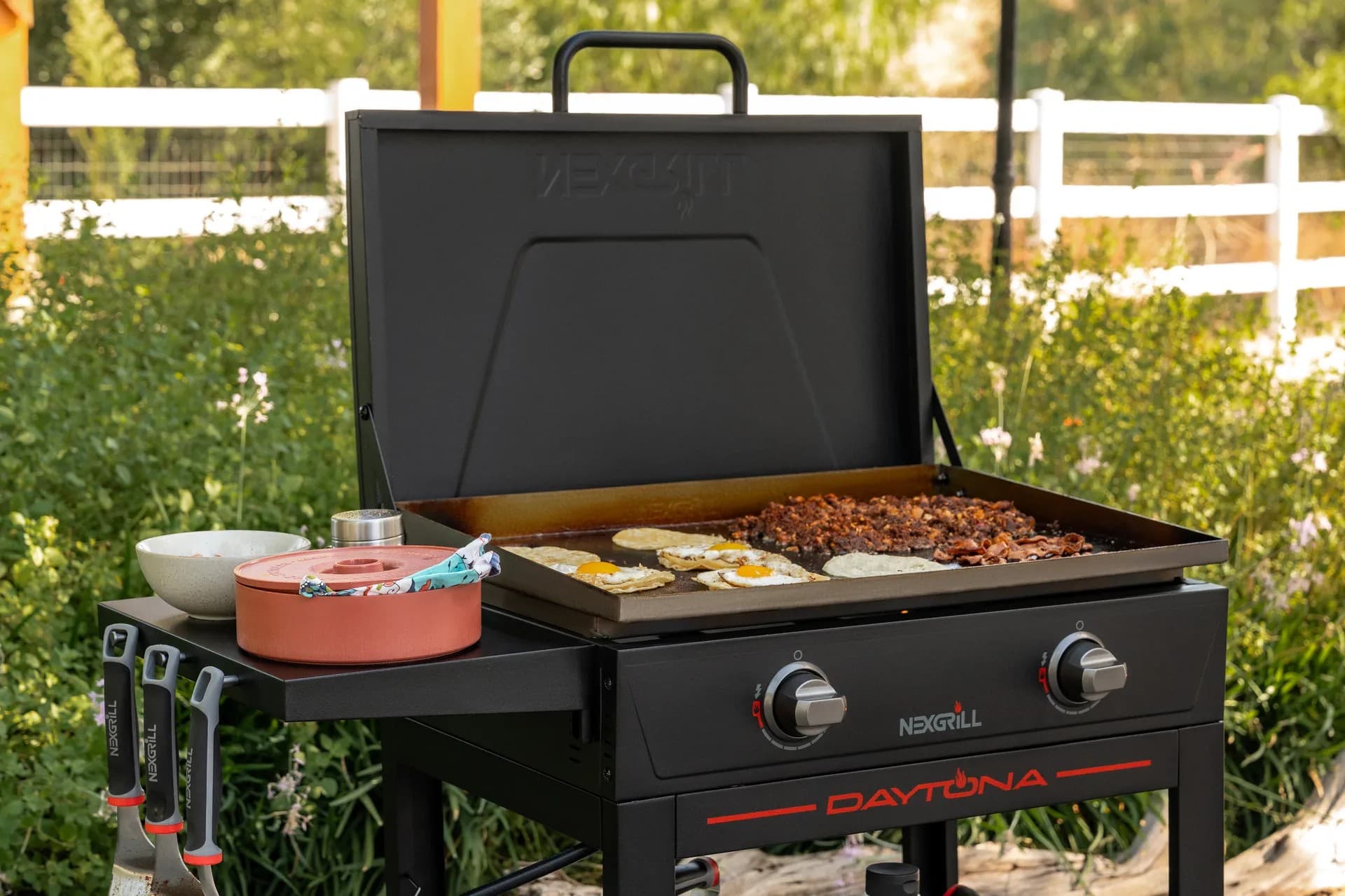
High-Quality Grill Thermometers: Get an Accurate Read Every Cook
A step-by-step workflow for choosing, calibrating, and caring for a grill thermometer that actually tells the truth about doneness.
In This Article
Match Thermometer to Cooker
Calibrate Before You Cook
Probe Care Extends Life
Dial In an Accurate Read in Five Steps
Most grillers who ruin a cook blame the meat, the fire, or the weather. In practice the culprit is usually a thermometer that lied - a lid dial reading 350°F while the grate sits at 275°F, or an instant-read with 8°F of drift telling you a pork loin is done when it is still 20°F short. This guide treats thermometry as a repeatable workflow you can run before, during, and after every cook, on any cooker from a Nexgrill gas grill to a kamado or pellet smoker.
You will need one instant-read for spot checks, one leave-in probe system with a separate ambient (pit) probe for long cooks, ice water and boiling water for calibration, and a plan for probe storage. From there the five-step loop is: calibrate, position, read, log, and re-verify.
Top-tier instant-reads like the Thermapen ONE are rated to ±0.5°F with a roughly 1-second read. Budget units often claim ±1-2°F but drift further in the field.
What 'High-Quality' Actually Means: Accuracy, Speed, and Ambience
Accuracy is the headline spec, but three properties decide whether a thermometer is genuinely good. Accuracy is how close the read is to truth. Response time is how fast the sensor reaches equilibrium - a 1-second read lets you check six chicken thighs before the lid cools. Ambient capability is whether the unit can also track pit temperature, which matters more than most buyers expect.
On a pellet smoker like the Oakford 875 or 1125 Pro, the ambient probe is doing the real work: a 15°F error in pit temperature over a 12-hour brisket is the difference between pulling at 12 hours and pulling at 15. A meat probe alone cannot tell you that.
Prerequisites: What You Need Before Your First Cook
- One instant-read thermometer (foldable or pen-style).
- One leave-in system with at least two probes on smokers and kamados.
- A tall glass of ice water and, at altitude, a boiling-point reference.
- A probe-safe resting spot: a magnet strip or drawer where cables stay coiled, not kinked.
Probe-cable junctions are the number-one failure point. Water ingress at the junction, not sensor death, kills most probes within a year.
Step-by-Step: A Repeatable Thermometer Workflow
Step 1 - Calibrate in ice water
Stir crushed ice and water, insert the probe 2 inches, and confirm a 32°F (0°C) read. Adjust or note the offset.
Step 2 - Set the ambient probe on the grate
Clip it at grate level near the meat, never against the lid.
Step 3 - Probe the thickest part, away from bone and fat
Insert to the thermal center, then read.
Step 4 - Compare against USDA minimums, then your preference
USDA FSIS sets whole pork, beef, veal, and lamb at 145°F with a 3-minute rest, ground meats at 160°F, and all poultry at 165°F. These are safety floors, not doneness targets - a brisket finishes near 203°F by feel, far above the floor.
Step 5 - Log and re-verify
Note the reading and re-check calibration monthly or after any drop.
Instant-Read vs. Leave-In vs. Wireless: A Type-by-Cooker Decision Table
| Cooker | Best thermometer type | Why |
|---|---|---|
| Oakford Pro pellet smoker | Leave-in multi-probe with ambient | Long, unattended cooks need pit tracking |
| Kamado | Leave-in, high-temp cable + ambient | Ceramic heat stresses standard cables |
| Weber kettle, 2-zone | Instant-read + leave-in for long cooks | Spot checks plus a safety net |
| Nexgrill 4-burner gas grill | Instant-read | Fast cooks, quick checks between turns |
| Daytona griddle | IR gun for surface, instant-read for interior | IR reads surface only |
| Rotisserie | Fully wireless meat probe | Cables would wrap the spit |
Analog Lid Dials and IR Guns: What They Can and Can't Do
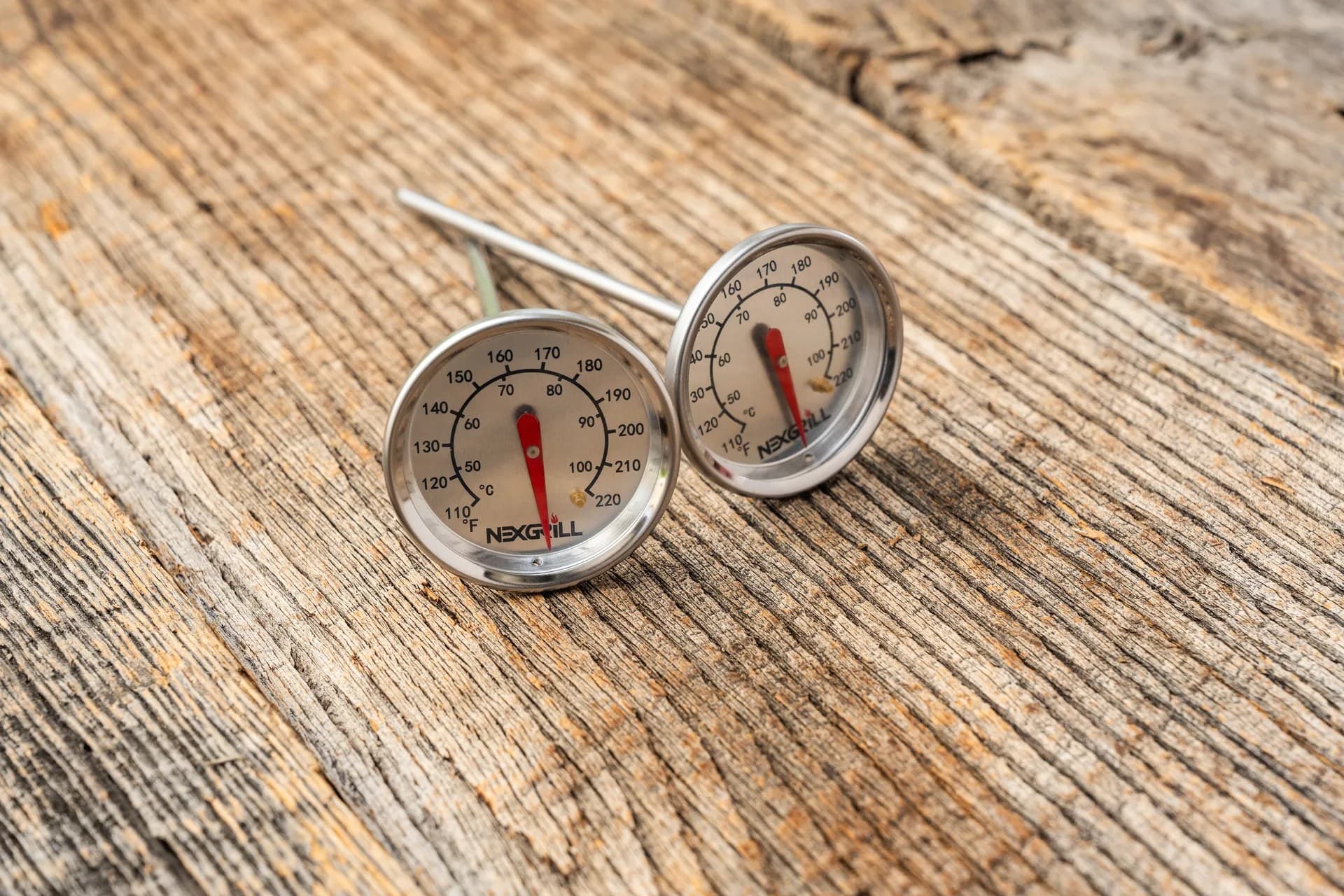
Analog dials are slow and prone to drift; treat them as rough ambient references, never doneness tools. US-made Tel-Tru dials are the quality end of that category. Infrared guns measure surface temperature only - reliable for a Daytona griddle plate, unreliable for internal meat.
Choosing Your Thermometer: What to Look For
Weigh five criteria: stated accuracy (±°F), response time, wireless range through walls, probe warranty length, and app quality. A ±0.5°F, 1-second instant-read plus a two-probe leave-in system covers nearly every home cook.
Compare two thermometers side by side below to see which fits your cooker and budget best:
Compare Two Thermometers Side by Side
Use the comparison tool below to put a budget instant-read against a premium pen, or a Bluetooth leave-in against an RF or Wi-Fi system, and see the spec differences that matter for your setup.
Once You've Compared, Here's What Else Matters
Spec sheets narrow the field, but the daily experience - range reliability, probe lifespan, and calibration discipline - decides whether a thermometer earns its place in your kit. The wireless question in particular is where buyers get burned.
RF vs. Bluetooth vs. Wi-Fi: Range and Reliability Tradeoffs
| Protocol | Typical range | Example | Tradeoff |
|---|---|---|---|
| RF (dedicated receiver) | Up to ~300 ft line-of-sight | ThermoWorks Smoke | No phone needed; separate base unit |
| Bluetooth | ~30-100 ft line-of-sight | MEATER Plus | Degrades sharply through walls |
| Wi-Fi (cloud) | Anywhere with internet | Fireboard 2, ThermoWorks Signals | Depends on home Wi-Fi uptime |
A Bluetooth claim of 100 ft usually means an open field. Through a brick wall and a door, expect a fraction of that. RF receivers still win for backyard reliability.
Probe Durability and Warranty: The Failure Point Nobody Explains
Most probe warranties run 6-12 months, and the dominant failure is moisture ingress at the probe-cable junction, followed by crimped cables. Extend life by keeping the junction out of water, coiling rather than kinking, and staying under the probe's rated maximum temperature.
Calibration: Ice-Water and Boiling-Point Methods
The ice-water method (32°F/0°C) is the standard field check and is altitude-independent. Boiling point is not: it is roughly 212°F at sea level and falls with elevation, so a Denver griller at 5,280 ft sees water boil near 203°F. Calibrate to ice water first, then adjust for your kitchen's altitude if you use the boiling check.
Common Probing Mistakes and How to Avoid Them
- Trusting the lid dial for doneness - it reads air, not meat.
- Skipping calibration before a big cook or after a drop.
- Probing fat, gristle, or bone instead of the thickest part.
- Kinking or submerging the probe-cable junction.
- Confusing USDA safety minimums with personal doneness preferences.
- Omitting a separate ambient probe on smokers and kamados.
Scenario Buying Advice: Weber Kettle, Oakford Smoker, Daytona Griddle
Kettle owner: a fast instant-read plus an inexpensive leave-in covers indirect cooks. Oakford Pro smoker owner: a two-probe leave-in with an ambient probe is non-negotiable. Daytona griddle owner: an IR gun for the plate plus an instant-read for patties and smash burgers. If your priority is tighter control rather than new gear, review the cookers themselves at Nexgrill's product collection.
Is a $100 Thermapen Worth It? A Value Calculation
A prime rib or brisket can cost $60-$120. A $15 instant-read that drifts 5°F can push either past done, and one ruined holiday cook exceeds the $85 gap between it and a ±0.5°F Thermapen ONE. That math holds even if the cheap unit lasts two seasons.
A Short Pre-Cook Checklist
- Ice-water calibrate.
- Measure at the thickest part, away from bone.
- Set the ambient probe on smokers and kamados.
- Verify wireless range through your actual walls.
- Store probes coiled and dry; re-verify monthly or after drops.